Call Us What We Carry by Amanda Gorman
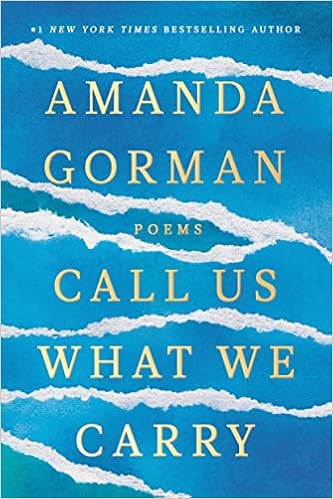
Amanda Gorman became the youngest inaugural poet when she recited “The Hill We Climb” in 2021. Her message and word choice were powerful when I watched the ceremony live, but having recently revisited the video, I can say Gorman’s poem also stands the test of time beautifully. Over winter break I got a copy of Gorman’s second book Call Us What We Carry from my aunt (who’s an author herself–not relevant, just interesting). It was with high expectations and the memory of her eloquence at Biden’s inauguration that I began Call Us What We Carry.
Let me start by saying that I have not finished the book (though I do think it’s hard to ever really finish a book of poetry because there’s always more to interpret). Even so, I have some thoughts. Part of what makes Gorman’s poetry so special is her unique word play. She puts “a kin” next to “akin” and “unprecedented” next to “unpresidented.” In her poem “The Hill We Climb” she writes, “for there is always light if only we’re brave enough to see it / if only we’re brave enough to be it.” Here, and in many other instances, she uses similar sounds to build upon her words and ideas. Because Gorman is so good at writing poems meant to be spoken aloud, it becomes a little problematic when she writes poems meant to be read.
On a page, words can easily lose their shape and rhythm. As a result, poets often experiment with formatting or fonts. Yet something is still lost in the transcription of a spoken poem onto paper. Or perhaps it’s the unfulfilling feeling of leaving a written poem unspoken. Whatever it is, when I read Gorman’s poems, I appreciate the clever word choice and interesting themes, but I can't help but wish I could listen to her read the poem out loud.
Formatting, too, can be an issue on its own. Although it is occasionally extremely successful in contributing to a unique feeling and reading experience (as in her poem “America™ ,” where the text fills an American flag), sometimes the formatting just becomes confusing. Gorman’s second poem in Call Us What We Carry, “Please,” consists of just ten words separated by inches of space. I understand that the space is likely meant to symbolize social distancing, but I feel that the poem did not have the powerful effect she was looking for, and instead came off as overly simplistic.
Nevertheless, I think Call Us What We Carry is still worth reading. Thus far in her book, Gorman has reached for COVID and the chaos of the past presidency quite a bit, but seeing as those two things have consumed our thoughts and shaped our lives over the past few years, I think it’s warranted. To anyone who reads the book, let me know what you think!
-Bonnie


Great blog post Bonnie!! I remember when I first heard Amanda's speech I was in awe at how amazing of a poet she was, however I never really followed up with her work. I totally see what you mean with formatting and poetry, that's always been an issue for me when reading poetry as well. Despite that, I think I might still give this book a try based on the content of the actual poems.
ReplyDeleteHi Bonnie! I think you made a lot of good points here. I saw Amanda Gorman's speech at the inauguration too, and I think I heard her speak one other time, but I didn't realize that she wrote a book too. I think what you're saying about the sort of rhythmic flow of the poems makes a lot of sense. The few times I've read poetry before I've had some issues with figuring that out myself. Thanks for the review and analysis! It's also cool that your aunt is an author! What has she written?
ReplyDeleteI like how you described your pre-reading journey in the first paragraph; it makes the review and experience all the more real. I agree with your take on poems as well; the formatting and rhythm poets incorporate to evoke emotion or emphasize details can be jarring at times, but they really help bring a story to life. Great review!
ReplyDelete